
More Content Is Making You Less Visible

Here's a number that should make every marketer and business owner stop scrolling for a second:
Over 328 million terabytes of data are created every single day on the internet.
Every. Single. Day.
That includes blog posts, social media updates, YouTube videos, podcasts, email newsletters, TikToks, LinkedIn carousels, Instagram Reels, and roughly seventeen thousand AI-generated listicles about "the top ten ways to leverage synergy in your Q2 pipeline" that nobody asked for and nobody read.
The content explosion is real. And here's the uncomfortable truth hiding inside that number: most of that content looks exactly the same.
Same topics. Same formats. Same five stock photo aesthetics. Same ChatGPT-flavored sentence structures that all somehow start with "In today's fast-paced digital landscape..." Same advice, repackaged and republished by a thousand different brands, all hoping to stand out by doing the exact same thing everyone else is doing.
This is what marketers are calling the Sea of Sameness. And if you're producing content for your business right now — even good content, even consistent content — there's a real chance you're swimming in it without knowing it.
How Did We Get Here?
The short answer is: AI made content cheap, and cheap content flooded the market.
For years, the barrier to producing content was effort. Writing a good blog post took hours. Recording a polished video took equipment, editing software, and a willingness to watch yourself on camera approximately forty times before hitting publish. Designing social graphics required either a designer or a painful afternoon in Canva trying to remember what "kerning" means.
Then AI tools arrived and dramatically lowered all of those barriers. Suddenly, anyone could produce a blog post in minutes. Social captions in seconds. Email newsletters on demand. And for a hot minute, that felt like pure upside — more content, less effort, what's not to love?
What's not to love is that everyone got the same memo at the same time.
When every brand has access to the same AI tools generating content from the same training data in response to the same prompts, the output starts to blur together. Not because AI is bad — it isn't — but because access to a tool isn't the same as a strategy for using it distinctively. The brands that dumped generic AI content into their feeds en masse didn't gain visibility. They contributed to the noise.
And audiences noticed. Engagement rates have been dropping across most platforms. Email open rates are increasingly competitive. Organic reach on social continues to squeeze. These aren't coincidences — they're signals. People are getting better at tuning out content that feels like content, rather than communication.
What the Algorithm Actually Rewards (And It's Not What You Think)
Here's where it gets interesting, and where a lot of conventional content advice starts to fall apart.
The knee-jerk response to "my content isn't getting traction" is usually "I need to post MORE." More frequently, more platforms, more formats, more volume. And that instinct is almost always wrong.
The platforms — Instagram, LinkedIn, YouTube, Google, and increasingly the AI-powered search tools we'll talk about in next week's post — don't actually reward volume. They reward relevance, specificity, and genuine engagement. They reward content that makes the right people stop, pay attention, and do something — click, comment, share, save, buy.
A single piece of content that genuinely resonates with 500 people in your exact target audience is worth more algorithmically, and infinitely more commercially, than 50 pieces of content that 10,000 people scroll past without registering.
This is a fundamental shift in how content strategy needs to work. The question is no longer "how much can we produce?" It's "how specifically can we speak to the people who actually need what we offer?"
The Difference Between Content and Communication
We want to make a distinction here that sounds simple but has big implications:
Content is what you publish when you're trying to be present. It fills a calendar. It checks a box. It exists.
Communication is what you publish when you have something specific to say to a specific person about a specific problem they have. It earns attention because it deserves attention.
Most brands are producing content. Very few are producing communication. And in a Sea of Sameness, communication is the only thing that cuts through.
What does that look like in practice? It looks like:
A local accountant who, instead of posting generic "tax tip Tuesday" content, writes specifically about the tax implications of a new Kansas small business regulation that just passed — because their clients are Wichita business owners who are directly affected and desperately need that information.
A fitness studio that, instead of posting motivational quotes and stock photos of people doing lunges, publishes real stories from real members about what it actually felt like to show up on hard days — because their audience is people struggling with consistency, not people who need a reminder that exercise is good.
A marketing agency that, instead of producing another "top ten social media tips" blog post, breaks down a specific campaign they ran for a specific client with specific results — because their prospects want proof, not principles.
Specific beats generic. Every time. In every format. On every platform.
So Where Does AI Fit In?
Here's the reframe that changes everything: AI isn't the problem. Lazy AI use is the problem.
The brands that are winning with content right now aren't using AI to replace their thinking. They're using AI to execute their thinking faster and at greater scale. There's a critical difference.
The strategy — who you're talking to, what they actually care about, what makes your brand's perspective distinct, what problems you uniquely solve — that still has to come from humans. From you. From the knowledge, experience, and relationships that no AI model was trained on because they live in your head and your community.
Once that thinking exists, AI becomes extraordinarily powerful. It can help you express that thinking in more formats, more frequently, more consistently, and with less of the friction that used to make content production feel like a grind. But it's an accelerant, not a replacement for the spark.
This is the core argument of Angie Callen's session at Digital Day — "Marketing in the Age of Infinite Content and the Sea of Sameness." Angie is a brand and content strategist who works with businesses on exactly this problem: how to develop a voice and a perspective that is genuinely distinct, and then use modern tools — including AI — to amplify that distinctiveness rather than dilute it.
Her session is hands-on. You won't just hear the theory; you'll actually work through frameworks for identifying what makes your brand's perspective worth paying attention to. If you've ever felt like your content is perfectly fine but somehow not landing the way you hoped, this session was built for that exact frustration.
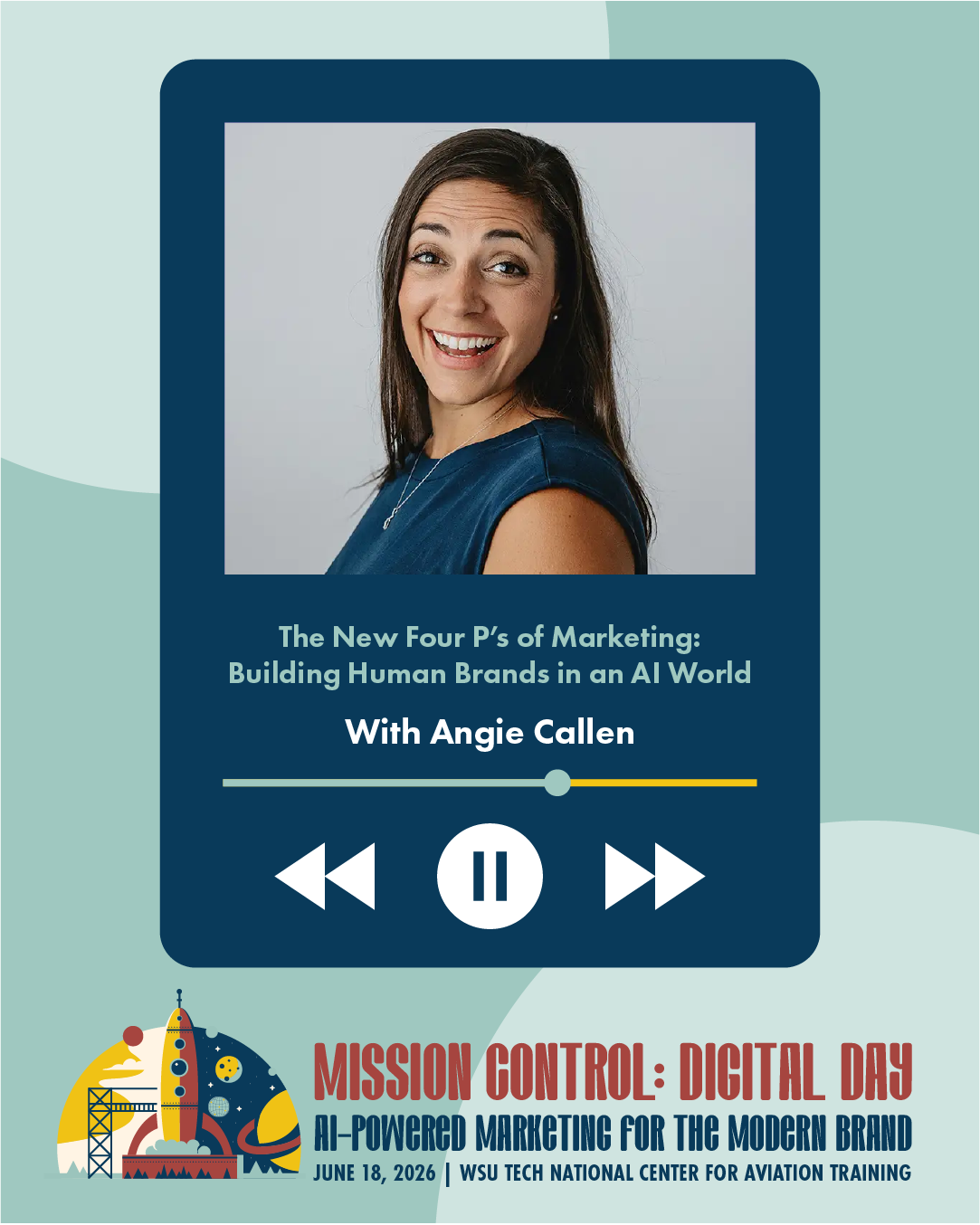
See Angie Callen
at Digital Day 2026!
A Quick Self-Diagnosis
Before we wrap, here's a fast gut-check for your own content. Ask yourself honestly:
Could your competitor publish this exact post and have it be equally true about their business?
If the answer is yes — or even "kind of" — that's a Sea of Sameness flag. Not a crisis, not a failure, just useful information. It means there's an opportunity to go more specific, more personal, more rooted in the things that are actually true about your business that aren't true about anyone else's.
Would your ideal customer recognize this content as being written specifically for them?
Not "for people like them" — for them. The more a piece of content feels like it was pulled from inside a reader's own head, the more powerful it is. That level of specificity is hard. It requires actually knowing your audience, not just knowing your product. But it's also the thing that separates brands that grow from brands that just stay busy.
The Bottom Line
More content is not the answer to a content problem. Better content — more specific, more human, more rooted in a genuine point of view — is the answer.
AI can help you produce that content at scale, but only if you bring the perspective that makes it worth producing in the first place. The brands that figure out that combination first are going to have a significant and compounding advantage over the ones still churning out generic posts and wondering why the algorithm isn't cooperating.
Angie Callen is going to show you how to find that combination at Digital Day on June 18th. And the good news is — you don't have to figure it out alone.
Get your tickets to Mission Control: Digital Day here. The Summit is June 18th at WSU Tech's NCAT Campus in Wichita. If you want to go deeper with the hands-on AI Agent Workshop on June 19th, grab a Liftoff+ ticket — those seats are limited to 100 and filling up.
Next week: Beyond SEO: What Is AEO, GEO, and Answer Optimization — And Why It Matters Right Now — if you've built your discoverability strategy around Google alone, this one is going to change how you think about being found online.
Digital Wichita has been connecting Wichita's digital marketing community since 2015. Now in our eleventh year, we're proud to bring Mission Control: Digital Day to WSU Tech's NCAT Campus this June.