
SEO Isn’t Dead… But It’s Not Enough Anymore
Let's play a quick game.
Think about the last time you searched for something online. Not something you were shopping for — something you genuinely needed to know. Maybe it was "how do I write off a home office on my taxes" or "what's the best CRM for a small team" or "is email marketing still worth it in 2026."
Now think about what happened next. Did you click through to a website and read an article? Or did you get your answer directly — in a summary box at the top of Google, in an AI-generated response, from ChatGPT, from Perplexity, from your phone's assistant?
If you're like most people, it was the second one. Increasingly, it's not even close.
This is the shift that's quietly rewriting the rules of how businesses get found online. And if your entire discoverability strategy is built around traditional SEO — ranking on page one of Google — you may already be optimizing for a game that's changing faster than most people realize.
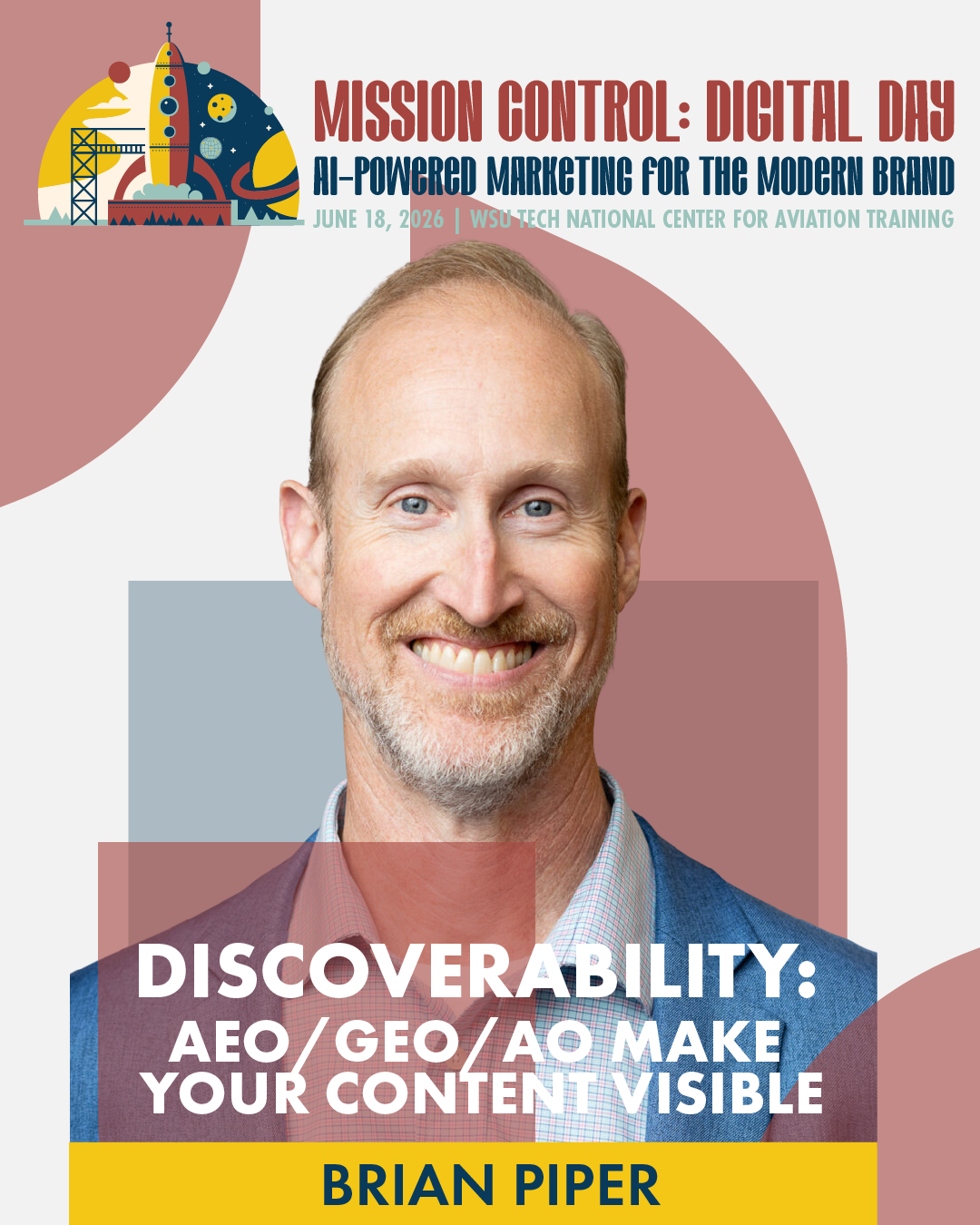
Enter AEO, GEO, and Answer Optimization. Three terms you're going to be hearing a lot more of, explained here in plain English before Brian Piper breaks them all down in depth at Digital Day on June 18th.
See Brian Piper
at Digital Day 2026!
First, a Quick Refresher on SEO (So We Know What We're Moving Beyond)
Search Engine Optimization — SEO — is the practice of making your website and content show up when people search for things on Google. You optimize your pages for specific keywords, build credibility through other websites linking to you, make sure your site loads fast and works on mobile, and over time, Google rewards you with higher rankings.
It works. It has worked for about 25 years. And it isn't going away entirely — Google still processes roughly 8.5 billion searches per day, and showing up in those results still matters.
But here's what's changed: the search results page itself looks completely different than it did even two years ago.
Type a question into Google today and you're increasingly likely to see an AI-generated answer at the very top — a synthesized response pulled from multiple sources — before you ever see a list of websites to click. Google calls this AI Overviews. Other search engines and AI tools do versions of the same thing.
Which means the goal is no longer just "rank on page one." The goal is "be the source that the AI cites when it answers the question." That's a fundamentally different challenge. And it requires a fundamentally different approach.
AEO: Answer Engine Optimization
AEO stands for Answer Engine Optimization, and it's exactly what it sounds like: optimizing your content to be chosen as the answer when someone asks a question — not just to appear in a list of results.
Think about the difference. Traditional SEO gets you on the list. AEO gets you chosen from the list — or better yet, gets you cited directly in the AI-generated answer that appears before the list even starts.
To understand why this matters, consider the way people actually search. More and more, especially with voice search and AI assistants, people aren't typing "email marketing Wichita." They're asking "what's the best way to do email marketing for a small business in Wichita?" Full questions. Conversational language. The way you'd ask a knowledgeable friend.
Traditional SEO was built for keywords. AEO is built for questions.
The practical implication: your content needs to actually answer questions. Clearly, specifically, and in a format that an AI can easily extract and cite. That means having dedicated sections that directly address specific questions your audience is asking. It means structuring your content with clarity — not burying the answer in paragraph seven. It means thinking less like a copywriter trying to sound impressive and more like a subject matter expert trying to be genuinely useful.
The good news: if you've been reading this blog series and thinking about producing more specific, audience-focused content (see last week's post on the Sea of Sameness), you're already thinking in the right direction. AEO and great content strategy point the same way.
GEO: Generative Engine Optimization
GEO stands for Generative Engine Optimization, and this one is newer — new enough that a lot of marketers are still figuring out what it means.
Here's the context: a growing number of people are now using AI tools — ChatGPT, Claude, Perplexity, Google Gemini, Microsoft Copilot — as their primary research tool instead of a traditional search engine. They're not Googling anymore. They're asking AI.
And when they ask AI a question about, say, the best marketing agencies in Wichita, or what software to use for email automation, or how to run a YouTube channel for a local business — the AI generates an answer by drawing on everything it knows. The question is: does it know about you?
GEO is the practice of making sure that AI systems have enough accurate, well-structured, and widely-referenced information about your business, your expertise, and your content that you show up in those AI-generated answers — even when the person asking didn't go anywhere near a traditional search engine.
It's a bit like the difference between being listed in the Yellow Pages (old SEO) and being the person that everyone in town recommends when someone asks around (GEO). The recommendation happens in a conversation — or in an AI chat — not on a search results page.
GEO is still evolving as a discipline, which is partly why Brian Piper's session at Digital Day is so timely. The brands that understand this now and start building for it are going to have a meaningful head start on the brands that wait until it's conventional wisdom.
AO: Answer Optimization (The Umbrella)
You'll also hear the term Answer Optimization — sometimes abbreviated AO — used as a broader umbrella that covers both AEO and GEO. If AEO is about being the answer on search engines, and GEO is about being the answer in AI-generated responses, AO is the strategic practice of making sure your brand is consistently the answer wherever someone asks a relevant question — regardless of the platform or tool they're using to ask it.
It's a useful mental model because it shifts the focus from "where do we rank" to "when our ideal customer asks a question we could answer, do they find us?" That reframe changes what you optimize for, what content you create, and how you measure whether your discoverability strategy is actually working.
What This Means for Your Business Right Now
You don't need to panic, and you don't need to throw out everything you've been doing. But you do need to start thinking about a few things:
Are you answering questions, or just publishing content? There's a difference between a blog post that talks around a topic and one that actually answers the specific questions your audience is typing — or speaking — into search and AI tools. The latter gets cited. The former gets scrolled past.
Are you building authority in your niche? AI systems cite sources they've seen consistently associated with a topic. If you've been producing content in your area of expertise for years, that's an asset right now. If you've been producing generic content about everything, it's less useful. Niche authority matters more than ever.
Is your business information accurate and consistent across the web? AI tools pull information from a lot of places — your website, your Google Business Profile, industry directories, news mentions, social profiles. Inconsistent information across those sources creates confusion and reduces the likelihood of being cited accurately. This is a basic hygiene issue, but it's one a surprising number of businesses haven't addressed.
Are you thinking about voice and conversational search? More searches happen via voice than ever before. Voice search is almost entirely question-based. If your content isn't structured to answer questions in natural language, it's invisible to a significant and growing portion of how people look for things.
Brian Piper at Digital Day: The Deep Dive
Brian Piper's session — "Discoverability: AEO, GEO, AO — Make Your Content Visible" — is going to go much further than what we've covered here. Brian works specifically on content strategy and digital discoverability, and this session will include practical frameworks for auditing your current content, identifying the gaps, and building a discoverability strategy that works across both traditional search and AI-generated responses.
It may be one of the most practically valuable sessions of the day — and it's also one of the most timely. The window to get ahead of this shift, rather than catching up to it, is right now. Six months from now, this won't be a forward-thinking topic anymore. It'll be table stakes.
The Bottom Line
SEO isn't dead. But it's no longer enough on its own.
The way people find information — and the way they find businesses — is changing rapidly, and the brands that adapt their content strategy to meet that change are going to have a significant advantage over the ones still optimizing exclusively for a 2019 version of Google.
AEO, GEO, and Answer Optimization are the next chapter. And Digital Day is where you get the map.
Grab your tickets to Mission Control: Digital Day here. The Summit is June 18th at WSU Tech's NCAT Campus in Wichita. Don't forget — the hands-on AI Agent Workshop with Dennis Yu on June 19th is capped at 100 seats and filling fast.
Next week: What Is a Content Factory? How Small Businesses Are Using AI to Produce Like a Media Company — we'll break down Dennis Yu's framework and show you what it actually looks like to build a content system that runs while you sleep.
Digital Wichita has been connecting Wichita's digital marketing community since 2015. Now in our eleventh year, we're proud to bring Mission Control: Digital Day to WSU Tech's NCAT Campus this June.