
AI Agents Explained
If you've spent any time in marketing circles lately — online, at a conference, or just reading the endless parade of LinkedIn posts from people who've apparently been "leveraging AI" since birth — you've probably heard the term "AI agent" thrown around like everyone already knows what it means.
They do not all know what it means.
And honestly? Neither did we, at first. The term sounds like something from a sci-fi movie — a digital entity running around doing mysterious tasks while you sleep. And while that's not entirely wrong, it's also not the full picture. So let's fix that.
In this post, we're going to explain what an AI agent actually is, using zero technical jargon, real-world analogies, and a healthy respect for the fact that you have an actual business to run and don't have time for fluff.
Let's Start With What You Already Know: ChatGPT
Most people's first real experience with AI was something like ChatGPT. You open a chat window, you type a question or a request, it responds. You type another thing, it responds again. Back and forth, like texting a very well-read friend who never sleeps and doesn't charge by the hour.
That's a conversational AI tool — and it's genuinely useful. You can use it to draft emails, brainstorm ideas, rewrite copy, summarize documents, and a hundred other things. If you haven't tried it yet, it's worth ten minutes of your time.
But here's the limitation: it waits. You have to go to it, give it a task, get a result, come back with the next task, get another result. It's reactive. It does what you ask, when you ask it, and then it sits there until you ask again.
An AI agent is different. An AI agent acts.
So What IS an AI Agent, Exactly?
Here's the simplest definition we can give you:
An AI agent is an AI system that can take a goal, break it into steps, and execute those steps — on its own, using the tools available to it — without you having to hold its hand through every single one.
Let's make that concrete.
Imagine you ask a regular AI tool to "research our top three competitors and summarize what they're doing on social media." It might give you some general thoughts, but it can't actually go look at those competitors' social profiles, pull recent posts, analyze engagement patterns, and compile findings — because it can't take actions in the world. It can only respond to what you give it.
Now imagine an AI agent with the same task. It could search the web for your competitors, visit their social profiles, review their recent content, identify patterns, compile all of that into a structured report, and drop it in your shared folder — while you were in a meeting. Without you doing anything except giving it the initial goal.
That's the difference. A regular AI tool responds. An AI agent executes.
The Intern Analogy (Our Favorite One)
We like to think of an AI agent as a very capable, very tireless intern who has access to a lot of tools.
A regular intern, you'd have to walk through every step: "Go to this website, look at this section, write down these numbers, put them in this spreadsheet, send it to me." Step by step, hand-holding required.
A great intern — one who really understands the goal — you can just say "I need a competitive analysis by Thursday" and they'll figure out how to get it done. They'll ask clarifying questions if they need to, use the tools available to them, and come back with a finished product.
An AI agent is that second kind of intern. Except it doesn't need sleep, it doesn't expense lunch, it doesn't take three days off over Labor Day weekend, and it can work on seventeen tasks simultaneously without getting overwhelmed.
The catch — and there is one, because there's always one — is that you still have to be a good manager. A capable intern given a vague goal will still produce a vague result. The quality of what an AI agent delivers is directly tied to the clarity of the goal you give it. We'll come back to that.
What Can an AI Agent Actually Do?
This is where it gets genuinely exciting for marketers and business owners. Here are some real, non-theoretical things AI agents can be set up to do:
Content creation pipelines. An agent can take a topic, research it, draft a blog post, optimize it for SEO, resize it into a social caption, and schedule it — all as one automated workflow. What used to take a content team a full day can happen in the background while you focus on something else.
Lead research and outreach prep. Give an agent a list of prospects and it can research each one, pull relevant details, draft personalized outreach messages tailored to each person, and flag the ones most worth your time. Not form letters — actually personalized messages based on real research.
Customer service triage. An agent can monitor incoming inquiries, categorize them by type and urgency, draft responses to the routine ones, and escalate the complex ones to a human — without any of those routine inquiries ever hitting your inbox.
Competitive monitoring. An agent can keep an eye on what your competitors are publishing, what people are saying about your industry, and what trends are emerging — and send you a weekly digest without you having to go looking for any of it.
Internal operations. Summarizing meeting notes, updating project management tools, generating reports from data — agents can handle a lot of the administrative labor that quietly eats hours out of your week.
None of these require you to write code. None of them require a technical background. They do require understanding what you want, being specific about it, and — at least at this stage of the technology — keeping a human in the loop to review and refine.
The "Agents" Session at Digital Day
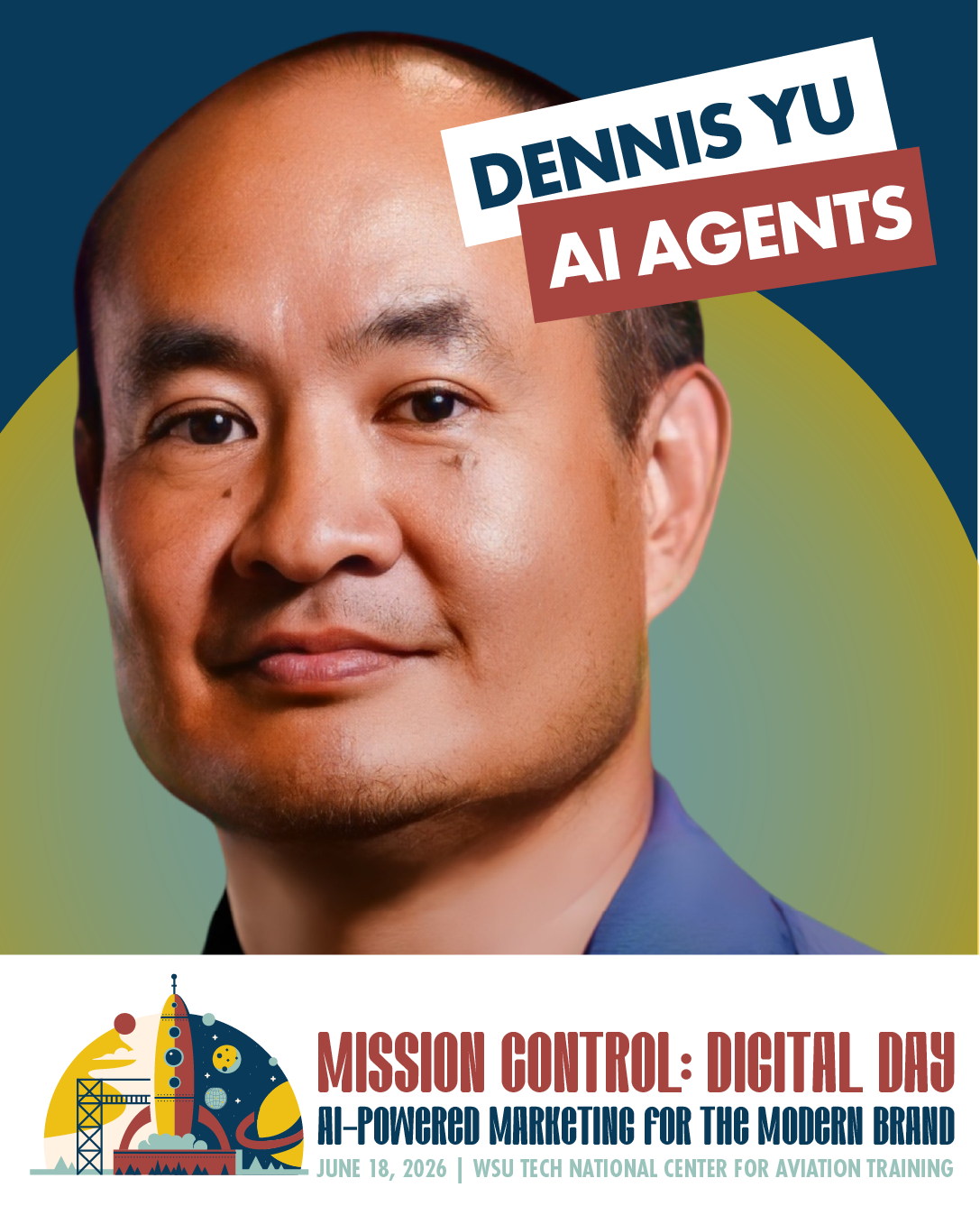
This is exactly what Dennis Yu is going to dig into during his session at Mission Control: Digital Day on June 18th — and even more deeply in the hands-on AI Agent Workshop on June 19th.
Dennis's framework is called the Local Content Factory, and it's built around the idea that small and mid-sized businesses can use AI agents to produce and distribute content at a scale that previously required a full marketing department. His session on June 18th will introduce the concept and show you real examples of it in action. His workshop on June 19th is where you actually build it — your own version, for your own business, with Dennis in the room.
The June 19th workshop is capped at 100 seats. At the time of writing, those seats are going. If you've read this far and thought "okay, I actually want to learn how to do this" — that's the room you want to be in.
See Dennis Yu
at Digital Day 2026!
The Part Nobody Talks About: What Agents Can't Do (Yet)
In the spirit of the plain-English approach we promised, let's be honest about the limitations too.
AI agents are not magic. They make mistakes. They occasionally misinterpret instructions in creative and mildly infuriating ways. They don't have judgment in the way humans do — they can execute a task brilliantly and still miss the point entirely if the goal wasn't defined well enough.
They also can't replace the human relationships, the creative intuition, the brand voice, and the strategic thinking that make great marketing great. That's not a disclaimer — that's actually the good news. It means the people who learn to use agents well aren't being replaced by them. They're being amplified by them. The human who knows how to direct an AI agent is dramatically more productive than the human who doesn't, and dramatically more valuable than the agent working alone.
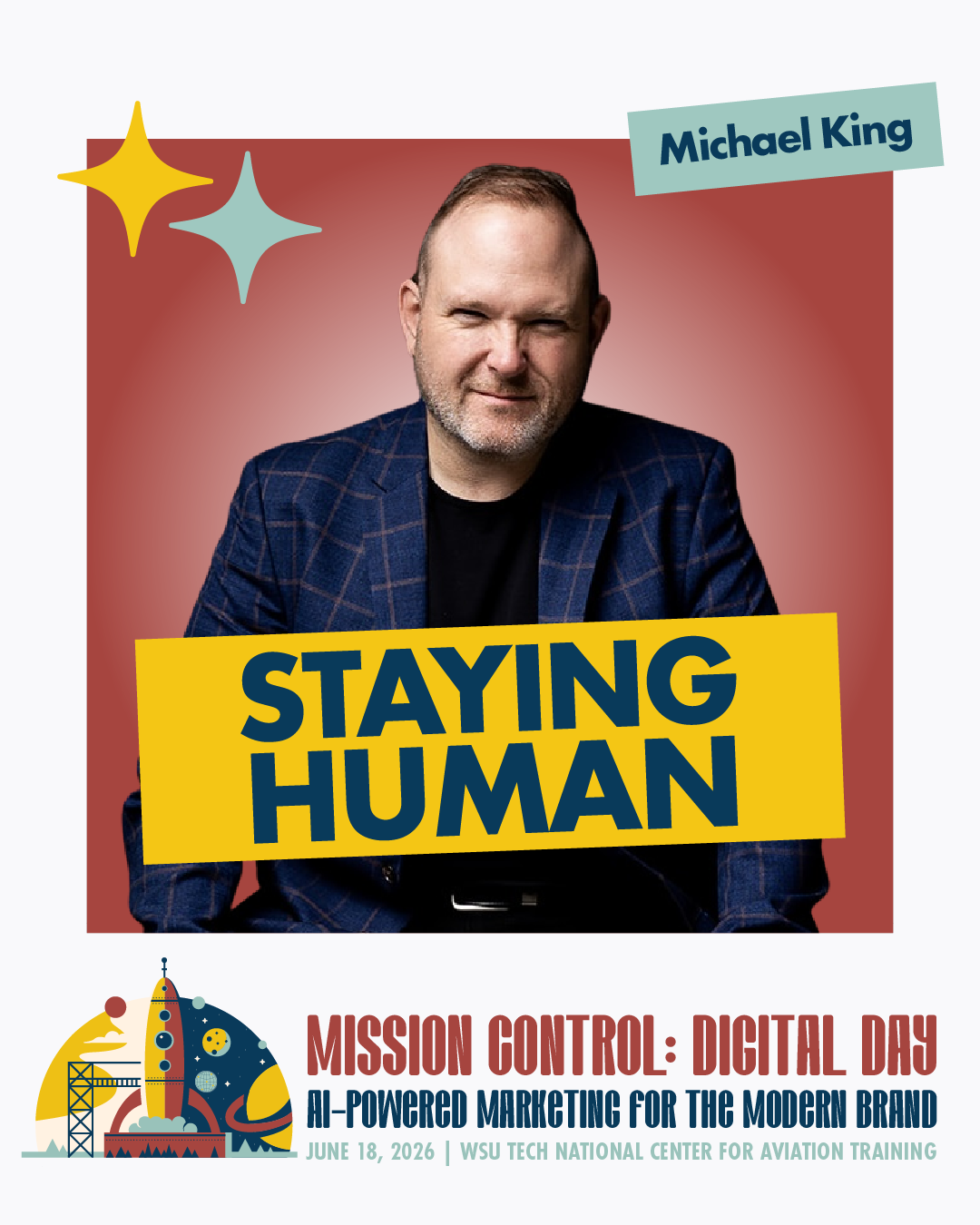
Michael King's session at Digital Day — about “staying human” — addresses this directly. It's one of the sessions we're most excited about, and it's a perfect bookend to everything Dennis Yu covers earlier in the day.
See Michael King
at Digital Day 2026!
So: Do You Need an AI Agent?
Probably not today, this minute, before you finish reading this post.
But if you are spending hours every week on tasks that are repetitive, research-heavy, or content-related — and most marketers and business owners are — then AI agents are worth understanding now, so you're ready to implement them strategically rather than frantically.
Digital Day is the place to get that understanding. Not from a textbook, not from a YouTube rabbit hole at 11pm, but from people who have built these systems and are using them in real businesses right now.
Next week: The "Sea of Sameness" Problem: Why More Content Is Making You Less Visible — we'll explain why the content explosion is actually working against most brands, and what to do instead.
Digital Wichita has been connecting Wichita's digital marketing community since 2015. Now in our eleventh year, we're proud to bring Mission Control: Digital Day to WSU Tech's NCAT Campus this June.