
Your Complete Guide to Digital Day 2026
Three weeks out.
If you've been following this blog series since March, you've spent the last several weeks getting smarter about AI marketing — what it is, what it isn't, and why it matters for your business right now. You've learned about AI agents, content factories, sea-of-sameness problems, YouTube strategies, image generation, discoverability, and the humans who are going to be teaching all of it live in Wichita on June 18th.
Now it's time to get practical.
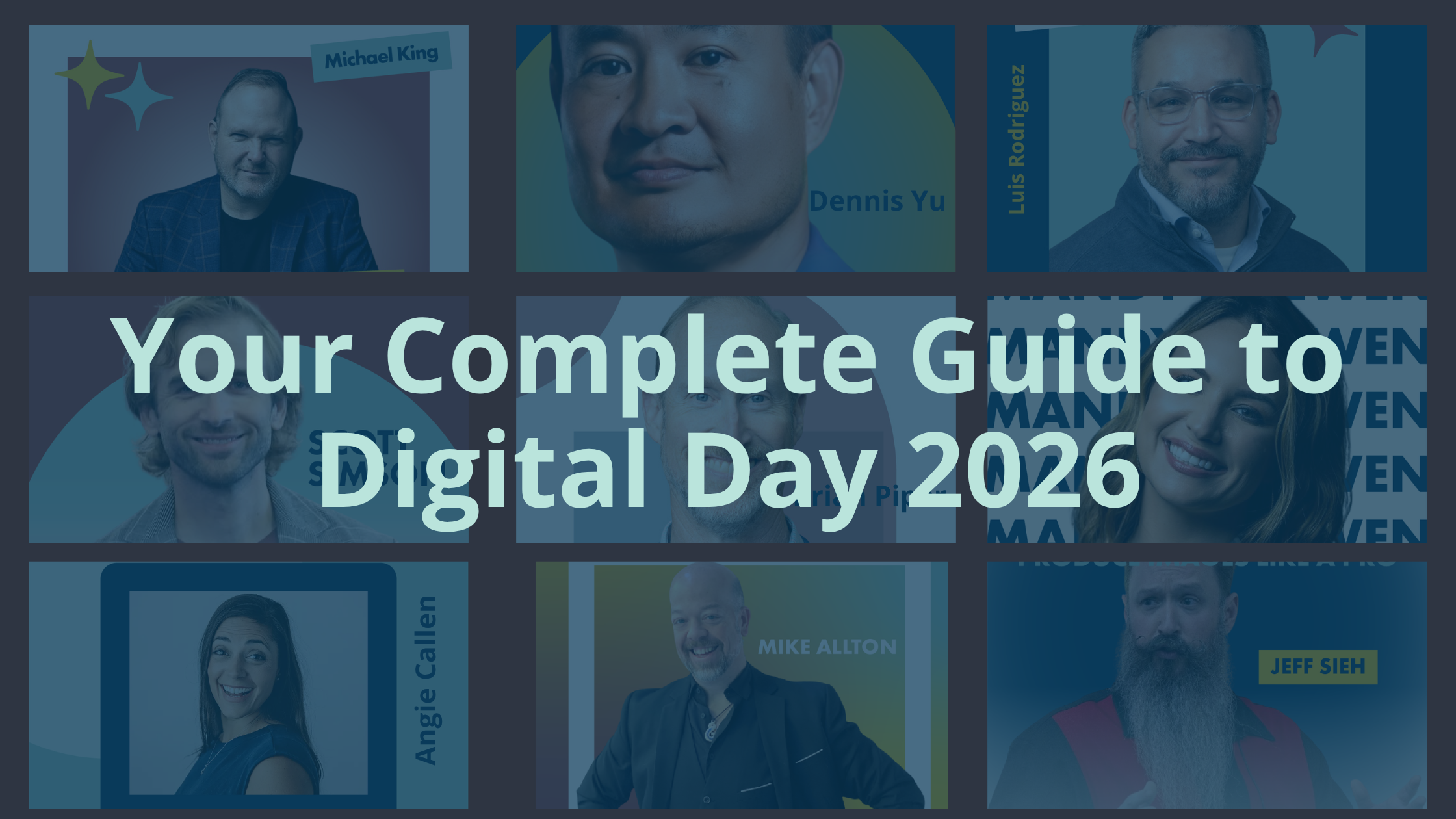
This is your official cheat sheet for Mission Control: Digital Day 2026. Every session, explained in plain English. Who it's for, what you'll walk away with, and — because we know you — which ones you absolutely cannot miss based on where you are in your AI journey.
Print it out. Screenshot it. Forward it to the colleague you've been trying to convince to come with you. (It's not too late. Tickets are still available.)
Let's go.
The Day at a Glance
Date: Thursday, June 18, 2026 Location: WSU Tech's National Center for Aviation Training (NCAT), 4004 North Webb Road, Wichita, KS 67226 Doors Open: 8:00 AM Summit Begins: 8:30 AM Parking: Free
Optional Add-On: Date: Friday, June 19, 2026 Location: Groover Labs, Wichita, KS Session: AI Agent Workshop with Dennis Yu — limited to 100 seats
Session by Session: What You Need to Know
Opening + Welcome
Emcees + Krissy Buck
Every great event needs a strong launch sequence, and Digital Day is no exception. Krissy Buck joins our emcees to kick off the day with the context, energy, and orientation you need to get the most out of everything that follows. Think of this as your mission briefing — the moment where everything clicks into place before the real work begins.
Who it's for: Everyone. Don't be late.
You'll walk away with: A clear sense of the day's arc, the themes connecting every session, and the kind of room-wide energy that reminds you why in-person events are worth showing up for.
The Current and Future Environment for AI and Work
Luis Rodriguez | No hands-on component
Before we get tactical, we get honest. Luis Rodriguez opens the educational programming with a grounded, research-informed look at the moment we're actually in — not the hype version, not the doom version, but the real version. What is AI doing to work right now? What's coming in the next 12 to 24 months? And what does all of it mean for the marketers and business owners in this room?
This session sets the foundation for everything that follows. It's the "here's where we are on the map" moment before we start navigating.
Who it's for: Everyone, but especially business owners and leaders who need clear language for talking about AI adoption with their teams, clients, or stakeholders.
You'll walk away with: A clear-eyed, non-panic-inducing framework for understanding where AI fits in the professional landscape right now — and a sharper sense of where the real opportunities are.
Marketing in the Age of Infinite Content and the Sea of Sameness
Angie Callen | Hands-on
Here's the uncomfortable truth Angie is going to address head-on: AI has made it possible for every brand to produce more content than ever before — and the result is a internet drowning in content that all looks and sounds the same. More posts. More blogs. More videos. Less cut-through.
Angie's session is about finding your way out of that sea. She works with businesses to excavate what is genuinely distinctive about them — the perspective, voice, and specific expertise that nobody else has — and build a content strategy that leads with that distinctiveness rather than burying it in a pile of generic AI output.
This session is hands-on, which means you'll actually work through some of Angie's frameworks in real time. Come with your brand's content challenges in mind. You're going to use them.
Who it's for: Anyone whose content feels consistent but not resonating. Anyone who has ever published something and thought "that's fine, I guess." Anyone who wants to understand why some brands cut through and others don't.
You'll walk away with: A framework for identifying your brand's genuine point of difference, and a starting point for a content strategy that actually sounds like you rather than everyone else.
Business Use Cases for AI
Mike Alton | Demo
There are roughly ten thousand articles on the internet about "AI tools for marketers." Most of them are lists of apps with screenshots and affiliate links. Mike Alton's session is the opposite of that.
Mike is a pragmatist. He's tested a lot of AI tools in real business contexts, and he has a clear-eyed view of what's delivering genuine ROI right now versus what's still more novelty than substance. His session focuses on the use cases that actually move the needle — the places where integrating AI into your marketing operation will save you real time, produce better results, or both.
Expect live demos, real examples, and the kind of honest "here's what works and here's what doesn't" perspective that's genuinely rare in the AI conversation right now.
Who it's for: Marketing managers, agency professionals, and business owners who want a practical, grounded guide to AI adoption — not a hype reel.
You'll walk away with: A prioritized list of the AI applications most worth your time and budget right now, and a clearer sense of how to evaluate new tools as they emerge.
Content and AI
Mandy McEwen | Demo
Mandy McEwen has been integrating AI into content operations since the earliest days these tools were available, and she brings a practitioner's depth to a topic that a lot of people are still approaching at the surface level.
Her session isn't about using AI to write your captions faster — although it can definitely do that. It's about AI as a strategic partner in your content operation: research, ideation, audience analysis, distribution strategy, and performance optimization. The difference between using AI as a shortcut and using AI as a system.
Live demos mean you'll see exactly how this works in practice, not just in theory.
Who it's for: Content marketers, social media managers, and anyone responsible for producing a consistent volume of content who wants to do it smarter, not just faster.
You'll walk away with: A clearer picture of where AI fits in a content workflow — and specific tools and techniques you can implement immediately.
Build Your AI Marketing Team: Agents, Content, and the Local Content Factory
Dennis Yu | Demo
This is the session we've been building to across this entire blog series. Dennis Yu's Local Content Factory framework is the connective tissue of Digital Day — the system that pulls together AI agents, content strategy, discoverability, and visual content into a coherent, scalable marketing operation that a small business can actually run.
Dennis will walk through the full framework live, show you real examples of it in action across businesses of different sizes and industries, and give you a clear picture of what your version of a Content Factory could look like. This is a demo session, which means you'll see the machinery running, not just hear about it.
If you're attending the June 19th workshop, this session is your foundation. If you're not — and you should be — this session is still one of the most practically valuable hours of the day.
Who it's for: Everyone. Genuinely. But especially small business owners and solo marketers who need to produce more without hiring more.
You'll walk away with: A clear understanding of the Content Factory framework and a mental model for how to build your own version — whether you do it at the workshop the next day or on your own timeline after the event.
AI-Powered Image Creation: Create Professional Visuals in Minutes
Jeff Sieh | Hands-on
Your phone is about to become a design studio. Jeff Sieh's hands-on session is the most immediately, visibly satisfying session of the day — because you will make things, in real time, that are better than you expected.
Jeff covers the AI image generation tools that are most useful for marketing purposes, the prompting techniques that separate professional-grade results from mediocre ones, and the practical workflow for integrating AI visuals into your content operation without sacrificing brand consistency.
Come with your phone charged and a sense of what kind of visuals your business needs more of. You're going to use both.
Who it's for: Anyone who produces visual content — which is everyone with a social media presence, a website, or a marketing function of any kind. Especially useful for small businesses and lean teams without dedicated design resources.
You'll walk away with: Practical prompting technique, a working knowledge of the best tools for marketing visual production, and probably a few images you'll actually use.
The "Netflix" Strategy: How to Get Views That Convert Into Clients With YouTube
Scott Simson | Hands-on
YouTube is the world's second largest search engine. Most businesses treat it like a broadcasting platform they're not quite committed enough to make work. Scott Simson is here to fix that.
His Netflix Strategy framework reframes YouTube entirely — from a platform where you compete for attention to a search engine where you earn discovery by being specific, consistent, and genuinely useful to the people searching for what you offer. His session is hands-on, which means you'll leave with an actual content strategy for your business, not just an understanding of the concept.
Who it's for: Business owners and marketers who have been meaning to "figure out YouTube" for longer than they'd like to admit. Also valuable for anyone already managing a YouTube channel who wants to understand why it's working — or why it isn't.
You'll walk away with: A clear YouTube content strategy tailored to your business, including the specific searches you should be optimizing for and a roadmap for your first (or next) series of videos.
Discoverability: AEO, GEO, AO — Make Your Content Visible
Brian Piper | Maybe hands-on
SEO is not dead. But if it's the only discoverability strategy you have, you're optimizing for a version of search that's already changing. Brian Piper's session covers the frontier of how content gets found — across traditional search, AI-generated responses, voice search, and the growing ecosystem of platforms where people look for information and businesses.
AEO (Answer Engine Optimization), GEO (Generative Engine Optimization), and Answer Optimization are the frameworks you need to make sure your content shows up not just on Google, but wherever your ideal customer is asking the questions you can answer. Brian will give you practical tools for auditing your current content and building a discoverability strategy that works across all of them.
Who it's for: Anyone responsible for content strategy, SEO, or organic marketing. Anyone whose website traffic has plateaued despite consistent content production. Anyone who wants to understand why AI-powered search tools sometimes cite their competitors and not them.
You'll walk away with: A practical framework for answer-optimized content and a clear action plan for improving your discoverability across both traditional and AI-powered search.
Staying Human in an AI-Driven World
Michael King
We saved the best for last — not because it's the flashiest session, but because it's the most important one.
Every other session at Digital Day is about what AI can do and how to use it. Michael King's session is about what you bring that AI can't replace — and why that distinction matters more now than it ever has.
As AI gets better at producing content, answering questions, generating visuals, and managing campaigns, the temptation is to automate everything you possibly can and let the machines run. Michael pushes back on that. Not because AI isn't powerful — it is — but because the brands that win long-term are the ones that use AI to amplify their humanity, not replace it. The trust, the relationships, the specific voice and perspective that makes your brand worth paying attention to — those things have to be protected, cultivated, and led by humans.
Michael closes Digital Day with the perspective that makes everything else you learned that day feel purposeful. Come tired from a full day of learning. Leave grounded in why it all matters.
Who it's for: Everyone. This is the session you'll still be thinking about a week later.
You'll walk away with: A framework for thinking about your role — as a marketer, as a business owner, as a human — in an increasingly AI-driven landscape. And probably a few things you want to write down before you leave the room.
The Liftoff+ Add-On: AI Agent Workshop with Dennis Yu
Friday, June 19 | Groover Labs | Limited to 100 seats
If June 18th is where you understand the Content Factory, June 19th is where you build it.
Dennis Yu's hands-on workshop is a half-day intensive at Groover Labs where attendees don't just learn the framework — they implement it. You will set up the beginning of your own AI-powered content system, with Dennis in the room to answer questions, troubleshoot, and push you past the moments where most people get stuck.
This is not a passive learning experience. It's a working session. Come with your laptop, come with your login credentials for the tools you use, and come ready to actually do things.
The workshop is strictly limited to 100 seats. It is the highest-implementation, most immediately practical session at Digital Day, and it fills up before the Summit does. If you're on the fence, consider this your nudge.
How to Get the Most Out of Digital Day
A few practical tips from eleven years of running this event:
Come with a specific challenge in mind. The attendees who get the most out of Digital Day are the ones who arrive with a real, specific problem they're trying to solve — not just a general interest in learning. "I want to understand AI" is fine. "I need a content system that doesn't depend entirely on me" is better. The more specific your challenge, the more directly the sessions will speak to it.
Talk to people. The hallway conversations at Digital Day are genuinely as valuable as the sessions. Wichita's marketing community is smart, generous, and full of people working on the same challenges you are. Introduce yourself. Ask questions. Share what's working and what isn't. Eleven years of this event has produced more collaborative relationships than we can count.
Take notes you'll actually use. Not a transcript — action items. For every session, ask yourself: what is the one thing I'm going to do differently starting Monday? Write that down. The sessions will give you a lot of information. The action items are what turn information into results.
Don't skip Michael King's closing session. We say this every year and people still occasionally duck out early to beat traffic. Don't be that person. The closing session is always the one people talk about most on the way home.
Three Weeks Out. Here's What to Do Right Now.
If you have your ticket: share this post with someone who's still on the fence. The more people from your community and your industry in that room, the richer the conversations — and the better the event is for everyone.
If you don't have your ticket yet: you still have time — but not as much as you think. The Summit is June 18th, just three weeks away. The Dennis Yu workshop has limited seats remaining. The time for "I'll get to it" is rapidly becoming "I missed it."
Get your tickets to Mission Control: Digital Day 2026 here.
Next week — we're diving into one of the most buzzed-about topics at this year's event: Is Your Brand Ready for the AI Era? How to Audit What You've Got Before June 18th. A practical self-assessment you can act on right now.