
The Netflix Effect: Turning Viewers Into Clients on YouTube
Quick question: when you think about YouTube for your business, what's the first image that pops into your head?
If we had to guess, it's probably one of two things. Either it's a highly produced channel with a charismatic host, perfect lighting, custom intro animations, and a subscriber count in the hundreds of thousands — the kind of thing that feels like it requires a production crew and a full-time social media manager just to maintain. Or it's that one video you uploaded two years ago that has 47 views and is mostly watched by your mom.
Neither of those pictures captures what YouTube actually is for most businesses that are using it well in 2026. And both of them are part of why so many perfectly good businesses have written YouTube off as "not really for us."
Here's the reframe that changes everything: YouTube is not a broadcasting platform. It's a search engine. The second largest search engine in the world, to be specific — second only to Google, which also happens to own it.
And once you see it that way, everything about how to use it for your business clicks into place.
Scott Simson is going to show you exactly how at Digital Day on June 18th. His session — "The Netflix Strategy: How to Get Views That Convert Into Clients With YouTube" — is one of the most anticipated of the day, and this post is your preview of why.
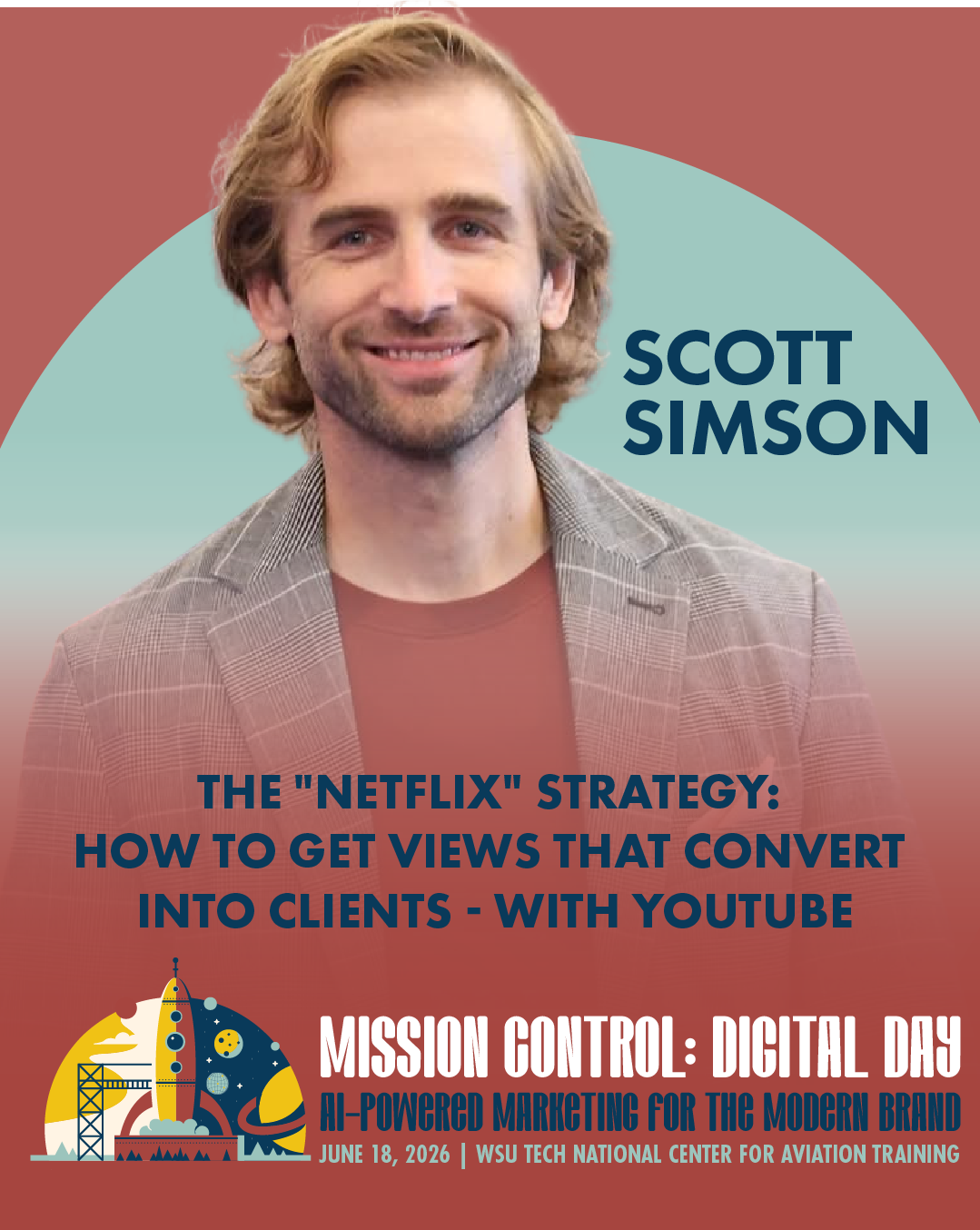
See Scott Simson
at Digital Day 2026!
Why Most Business YouTube Channels Go Nowhere
Before we get into what works, let's talk honestly about what doesn't — because there's a very common YouTube mistake that kills business channels before they ever get traction, and it almost certainly explains that 47-view video.
Most businesses approach YouTube like they approach Instagram or Facebook: they try to be entertaining, they post when they have something interesting to share, they chase trends, and they measure success by views and likes. And then they wonder why nothing happens.
The problem is that Instagram and Facebook are passive consumption platforms — people scroll through them without a specific intent, and you're trying to catch their attention mid-scroll. YouTube is an active search platform — people come to it with a specific question or goal, type it into the search bar, and watch videos that answer it.
The algorithm rewards very different things on each platform. On Instagram, novelty and entertainment drive reach. On YouTube, relevance and watch time drive reach. A video that answers a specific question thoroughly — even if it's not flashy, even if the presenter isn't particularly charismatic, even if it only gets a few hundred views — can drive traffic and generate leads for years. That's not how any other social platform works.
The businesses that crack YouTube aren't the ones with the highest production values or the most subscribers. They're the ones who figure out what their ideal customers are searching for, make videos that answer those searches comprehensively, and let the platform's search engine do the distribution work for them.
The Netflix Strategy: What It Actually Means
Scott's framework is built around a concept he calls the Netflix Strategy, and it's worth unpacking because it reframes what "good YouTube content" looks like for a business.
Netflix doesn't just produce content randomly. It studies what its audience wants to watch, produces content specifically designed to satisfy those wants, and organizes that content so the right viewer finds the right show at the right moment. The result is a content library that feels almost eerily relevant to whoever is browsing it — because for any given viewer, it is.
The Netflix Strategy for YouTube works on the same principle, applied to your business and your audience.
Instead of asking "what should I make a video about?" — which leads to either paralysis or random content — you start by asking "what are my ideal clients searching for on YouTube right now?" Those searches become your content map. Every video you make is a direct, deliberate answer to a question your prospective clients are already asking.
Over time, as you build out that library of specific, searchable videos, something powerful happens. A prospective client finds one of your videos while searching for an answer. They watch it, they find it genuinely helpful, and they see a link to another video of yours that's also relevant to them. Then another. Before long, they've spent twenty minutes in your content ecosystem — learning from you, building trust with you, deciding you know what you're talking about — and they haven't even spoken to you yet.
That's the Netflix effect. You're not chasing them with ads. You're not cold-pitching them in their inbox. They came to you, self-qualified, and warmed themselves up. The sale, when it comes, feels less like a sale and more like a natural next step.
The AI Layer: Where It Gets Really Interesting
Here's where Scott's session connects directly to the broader theme of Digital Day: AI has changed what's possible on YouTube in ways that most businesses haven't caught up to yet.
A few years ago, building a searchable YouTube library required significant time investment — researching what people were searching for, scripting videos, filming, editing, optimizing titles and descriptions for search. For a small business owner without a dedicated video team, that was a real barrier.
AI has dramatically lowered that barrier. Not by making generic videos — that's a fast path to the Sea of Sameness problem we talked about two posts ago — but by handling the research, the optimization, and a lot of the post-production work that used to eat hours.
AI tools can now analyze what your target audience is searching for on YouTube with a level of specificity that would have taken days of manual research. They can help you structure a video so it answers the search query thoroughly and keeps viewers watching. They can generate optimized titles, descriptions, and tags that dramatically increase the likelihood of your video appearing in search results. They can even help with transcripts and captions, which matters both for accessibility and for YouTube's algorithm.
The human part — the expertise, the trust, the specific knowledge that makes your content genuinely useful — still has to come from you. But the infrastructure that makes that content findable, watchable, and algorithmically favored? AI can handle a lot more of that than it used to.
What About Views? Does My Channel Need to Be Big to Matter?
This is the question that stops a lot of business owners from even starting on YouTube — the assumption that if you don't have thousands of subscribers, the platform isn't working for you.
It's one of the most persistent and most damaging myths about YouTube for business, and Scott addresses it directly.
Here's the reality: for most businesses, the goal on YouTube is not mass reach. It's targeted reach. A personal injury attorney in Wichita doesn't need a million views. They need the right five hundred people in the Wichita area who are searching for information about their specific legal situation to find their videos, trust their expertise, and pick up the phone.
A YouTube channel with 300 subscribers and 20 well-optimized videos that collectively answer every question a prospective client might have is worth more to that attorney than a channel with 50,000 subscribers and 200 random videos that don't convert to anything.
The metric that matters isn't views. It's whether the right people are watching — and what they do after.
YouTube as a Long-Term Asset
Here's something that distinguishes YouTube from almost every other content platform: the content you publish today can generate leads five years from now.
A Facebook post from 2021 is essentially dead. An Instagram Reel from last year has faded into the void. But a YouTube video that answers a specific search query? It stays searchable. It accumulates views over time. It keeps working long after you've stopped thinking about it.
For a small business with limited time and resources, that compounding return on investment is enormous. You're not just creating content for today — you're building a library of searchable assets that work for your business around the clock, indefinitely.
This is why businesses that commit to YouTube early — even if they start small, even if their first ten videos aren't perfect — end up with such a significant advantage over competitors who wait until they feel "ready." The library takes time to build. The sooner you start building it, the sooner it starts compounding.
What You'll Take Away from Scott's Session
Scott Simson's session at Digital Day on June 18th is hands-on, which means you won't just hear the strategy — you'll start applying it. By the end of the session, you'll have a clear sense of what your business's YouTube content strategy should look like, what specific searches you should be optimizing for, and what your first (or next) video should actually be about.
For business owners who have been meaning to "figure out YouTube" for the last three years, this session is the push and the practical framework you've been waiting for.
And for the marketers in the room who are already managing YouTube channels — there's a strong chance this session will reframe what you've been doing and show you why some things are working and others aren't.
The Bottom Line
YouTube is not for influencers. It's not for brands with big production budgets. And it's definitely not dead, despite what the people who haven't figured it out yet would like to believe.
It's the world's second largest search engine, and it rewards consistency, specificity, and genuine usefulness — not production polish or subscriber counts. With AI handling more of the optimization and production infrastructure, the barrier to building a business YouTube channel that actually generates clients has never been lower.
Scott Simson is going to show you exactly how to clear it on June 18th.
Get your tickets to Mission Control: Digital Day here. The Summit is June 18th at WSU Tech's NCAT Campus in Wichita. The AI Agent Workshop with Dennis Yu on June 19th is still available — but with 100 seats total, don't sit on it.
Next week: AI Image Generation for Marketers: Create Professional Visuals Without a Designer — Jeff Sieh joins us to show what's now possible with AI-generated imagery, and why your visual content strategy needs a serious rethink.